Along the shores of Ivory Coast, an exciting story with a hopeful ending is quietly unfolding. With support from Born Free USA, Ivory Coast authorities recently launched community outreach activities focused on the urgent need to protect Critically Endangered and Threatened marine species along the Fresco–Sassandra coastline in the southwestern part of the country. As they reached the area to start this work, a baby manatee was found tangled in a fishing net, exhausted and unable to free itself. Linking with the fisherman who had caught the calf, they were able to rescue the baby and made arrangements to ensure the fisherman would care for the calf who was too young to be released. The fisherman has slowly been nursing the calf back to health and the situation is being closely monitored. When the calf is stronger, and once the nets have been cleared from the area, the manatee will be returned to the wild where he belongs.
It’s a small story, but it captures exactly why Born Free USA is working along the West African coast and why the species at the core of this story deserves far more attention than it usually gets.
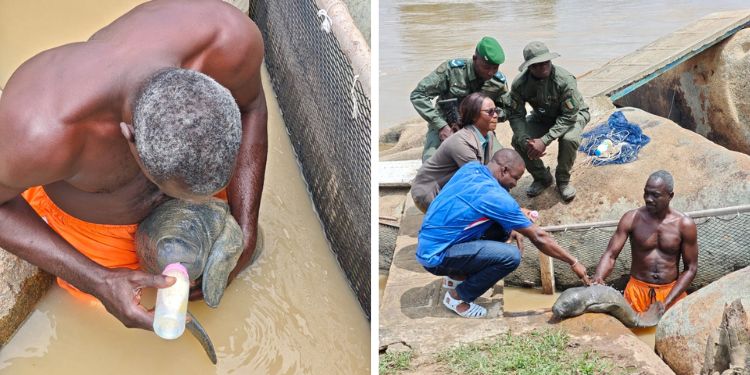
Meet the West African Manatee (Trichechus senegalensis)
Manatees are often called “sea cows,” and it’s an affectionate, fitting name. These slow-moving, barrel-shaped mammals can measure around 15 feet (4.5 meters) and weigh nearly 900 lb. (400 kilograms). They spend much of the day grazing peacefully on aquatic plants, drifting through shallow coastal waters, lagoons, and rivers. They are gentle, curious, completely harmless, and have no natural predators. They are the “mermaids” who inspired mythology and sailors’ stories.
A Species Under Pressure
Behind that gentle image is a species in trouble. The West African manatee has been classified as “Vulnerable” on the IUCN Red List since 1986, and the pressures affecting it continue to grow each year.
The greatest threats are mostly human-related. Manatees are frequently accidentally caught in fishing nets as bycatch, which sadly, can be fatal. They are also hunted for their meat, oil, and skin across much of their range. And their habitat is shrinking as community areas expand. Mangroves are cut for firewood, rivers are dammed, and coastlines are developed, slowly depleting the coast of all the grass and plants these animals depend on.
To make it even more difficult, manatees reproduce slowly. Females typically raise a single calf every few years, and young animals depend on their mothers for a long time. Their population simply cannot bounce back quickly. That is why every individual, including one small, rescued calf, genuinely matters so much.
Why Are Manatees so Important for the Region?
Manatees act as gardeners of coastal waters and rivers. By foraging on seagrasses and aquatic plants, they prevent vegetation from overgrowing and promote healthier, more diverse plant growth. Their grazing and their waste also help recycle nutrients through the water.
Those seagrass beds and mangroves are among the most productive habitats on Earth. They are nurseries and feeding grounds for the fish, shrimp, and crabs that coastal communities depend on for their livelihoods. A healthy manatee population is a sign of a healthy coastal ecosystem, which means healthier fisheries and more resilient shorelines for the people who live alongside them.
Protecting Marine Life in Fresco and Sassandra
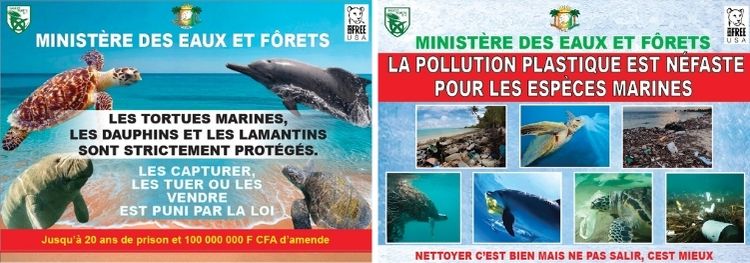
This is where Born Free USA comes in. Along the Fresco–Sassandra coastline in Ivory Coast, we are working to strengthen protections for threatened marine species, including the West African manatee, the Critically Endangered Atlantic humpback dolphin, and several sea turtle species.
Much of that work comes down to awareness and early action. When fishing communities and local authorities can recognise a protected species and understand why it matters, they can respond to accidents quickly and save lives, one at a time. We’re therefore working to protect the critical habitats these species rely on – nesting beaches, mangroves, coastal waters – and to strengthen cooperation between communities, fisheries, and government so that such awareness withstands over the long term.
The rescued calf is a perfect example of that approach working. There is currently a plan to clear the nets before releasing the baby manatee back into safe waters. All is possible when people are informed, engaged, and given the tools to act. That is precisely what this project sets out to build, community by community.
How You Can Help
The story of one baby manatee reminds us that conservation isn’t abstract. It comes down to the right people making the right choice at the right moment. But that only happens when the support is there to make it possible. Our current work on plastic pollution, in collaboration with local communities and authorities across West Africa, is a strong example of how biodiversity initiatives strengthen the protection of endemic species.
Support our work, so that more manatees, dolphins, and sea turtles get the second chance this baby manatee is getting right now.
Keep Wildlife in the Wild,
Alice
Dear Reader,
We are a nonprofit committed to wildlife conservation, welfare, and rescue. Making resources free and widely distributed, like our news items, is an important part of our mission. If you found this article helpful, enjoyable, or enlightening, please donate to help keep these resources available, and Keep Wildlife In The Wild.
Thank You,
The Born Free USA Team

 Dear Reader,