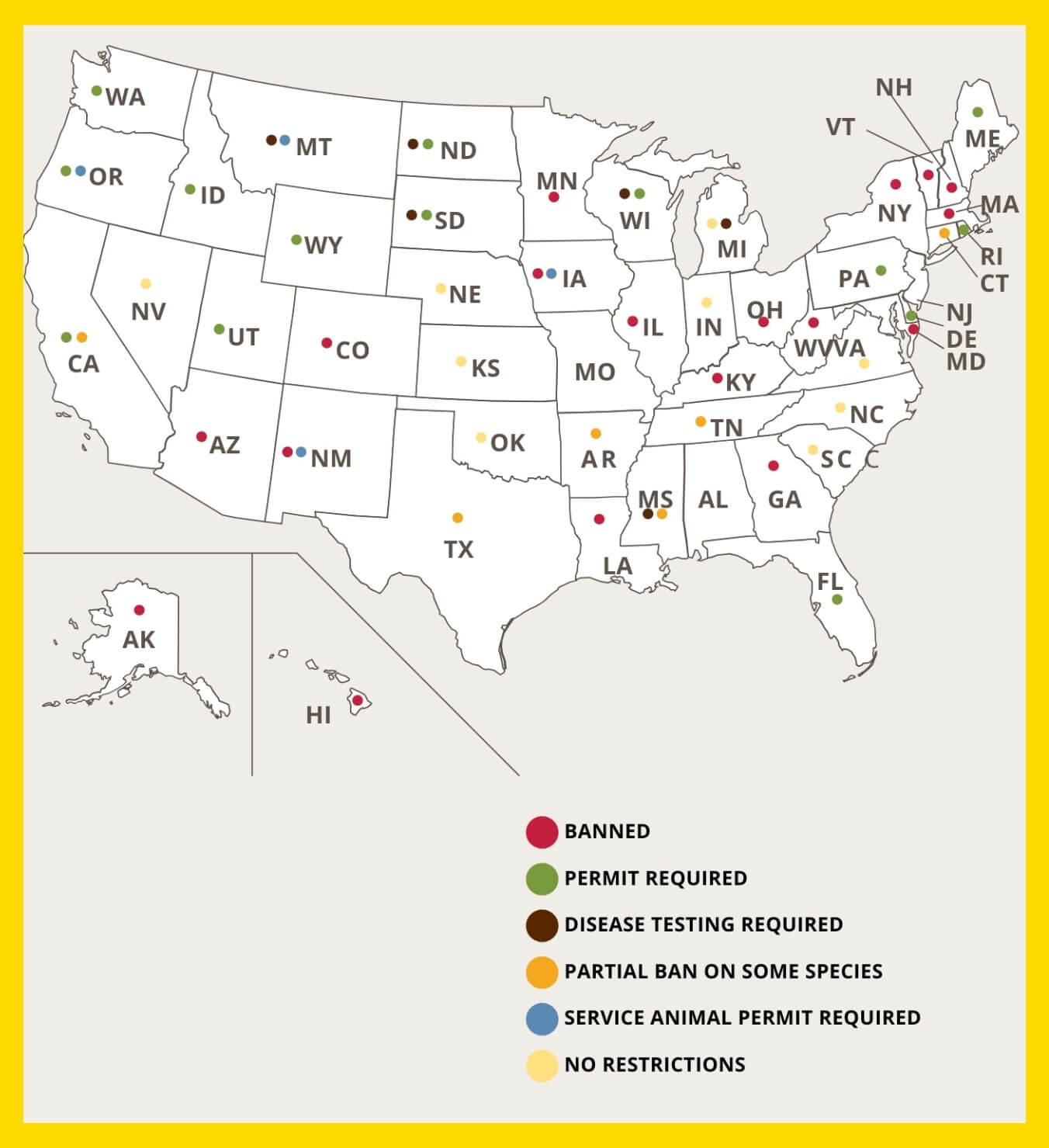
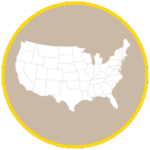
Map of Primate Pet Ownership Legislation
Twenty-one states have already taken steps to explicitly ban private ownership of primates. The legislation differs immensely between the remaining 29 states: 13 states require a permit or license; six states require disease testing; and six states partially ban or require permits for some species but not all. Nine states do not have any permit or licensing requirements relating to primates at all.
About the Captive Primate Safety Act
Representative Mile Quigley (D-IL) introduced the Captive Primate Safety Act in the House on May 5, 2025 (H.R. 3199/S. 1594), alongside other bill co-leads Rep. Brian Fitzpatrick (R-PA), Rep. Julia Brownley (D-CA), and Rep. Nancy Mace (R-NC). Senator Blumenthal (D-CT) also introduced the Senate companion bill on May 5. This bipartisan and bicameral legislation provides a critical solution to the cruel and dangerous pet trade in nonhuman primates. Specifically, the bill would amend the Lacey Act to prohibit the private possession of primate species (such as chimpanzees, gibbons, gorillas, lemurs, lorises, monkeys, orangutans, and tarsiers). This prohibition is narrowly focused on the primates kept as “pets”, and exempts zoos, research facilities, sanctuaries, and universities. Current private owners would be grandfathered in and are simply required to register their animals to ensure that first responders and other local authorities are aware of the presence of wild animals in their communities.
The Captive Primate Safety Act is Endorsed by…
Animal Welfare and Conservation Organizations
American Anti-Vivisection Society, Animal Legal Defense Fund, Animal Welfare Institute, Born Free USA, Four Paws USA, Friends of Animals, Humane Society Legislative Fund, Humane Society of the United States, International Fund for Animal Welfare, Monitor Conservation Research Society, People for the Ethical Treatment of Animals, Endangered Primate Foundation, Navarre Beach Sea Turtle Conservation Center, Humane Society of Louisiana, Carrie Murray Nature Center, Animal Protection Voters New Mexico, Friends of Washoe, International Crane Foundation.
Sanctuaries and Sanctuary Organizations
North American Primate Sanctuary Alliance, Global Federation of Animal Sanctuaries, Pan African Sanctuary Alliance (PASA), Turpentine Creek Wildlife Refuge, Lions, Tigers, & Bears, Performing Animal Welfare Society (PAWS), Lemur Conservation Foundation, Forest Animal Rescue, Black Pine Animal Sanctuary, Primate Rescue Center, Inc., Chimp Haven, The Wildcat Sanctuary, Oklahoma Primate Sanctuary, Oregon Primate Rescue, Black Beauty Ranch, Born Free USA Primate Sanctuary, Primarily Primates, Wildlife Rescue & Rehabilitation, The Elephant Sanctuary of Tennessee, Chimpanzee Sanctuary Northwest, Primates Incorporated, Fauna Foundation, Liberia Chimpanzee Rescue.
Zoo and Zoo Organizations
American Association of Zoo Veterinarians, Association of Zoos and Aquariums, AZA’s Wildlife Trafficking Alliance, The Elgin Center, Birmingham Zoo, Phoenix Zoo, Reid Park Zoo, Arizona-Sonora Desert Museum, Little Rock Zoo, Cabrillo Marine Aquarium, Charles Paddock Zoo, The Living Desert Zoo & Gardens, Los Angeles Zoo, Micke Grove Zoo, Oakland Zoo, San Diego Zoo Wildlife Alliance, San Francisco Zoo & Gardens, Santa Barbara Zoo, Denver Zoo Conservation Alliance, Pueblo Zoo, Beardsley Zoo, Brevard Zoo, Central Florida Zoo & Botanical Gardens, Jacksonville Zoo & Gardens, Lion Country Safari, Naples Zoo, Palm Beach Zoo, Zoo Atlanta, Lincoln Park Zoo, John G. Shedd Aquarium, Miller Park Zoo, Scovill Zoo, Cosley Zoo, Fort Wayne Children’s Zoo, Indianapolis Zoo, Potawatomi Zoo, National Mississippi River Museum & Aquarium, Sedgwick County Zoo, Rolling Hills Zoo, David Traylor Zoo of Emporia, Louisville Zoo, Audubon Nature Institute, Maryland Zoo, National Aquarium, >Zoo New England, Detroit Zoological Society, John Ball Zoo, Potter Park Zoo, Como Park Zoo and Conservatory, Saint Louis Zoo<, Zoo Montana, Omaha's Henry Doorly Zoo, Lee G. Simmons Wildlife Safari Park, Bergen County Zoological Park, Essex County Turtle Back Zoo, Jenkinson's Aquarium, ABQ Biopark Zoo, Aquarium of Niagara, Utica Zoo, Greensboro Science Center, >North Carolina Aquarium Society, Red River Zoo, Akron Zoo, Cincinnati Zoo & Botanical Garden, Columbus Zoo, >The Wilds, Cleveland Metroparks Zoo, Toledo Zoo & Aquarium, Oklahoma City Zoo, Tulsa Zoo, Oregon Zoo, Oregon Coast Aquarium, Philadelphia Zoo, Lehigh Valley Zoo, Great Plains Zoo, Memphis Zoo, Zoo Knoxville, Tennessee Aquarium, Chattanooga Zoo, Abilene Zoo, Dallas Zoo, El Paso Zoo, Houston Zoo, Moody Gardens, San Antonio Zoo, Loveland Living Planet Aquarium, Northwest Trek Wildlife Park, Point Defiance Zoo & Aquarium, Woodland Park Zoo, Oglebay’s Good Zoo, Milwaukee County Zoo, New Zoo & Adventure Park, >Racine Zoo, Toronto Zoo.
Law Enforcement Organizations and Individuals
Association of Prosecuting Attorneys, National Animal Care & Control Association, National Sheriffs Association, Animal Cruelty and Abuse Committee, Small & Rural Law Enforcement Executives Association, Tim Harrison, Retired Police Officer/Firefighter/EMT-Paramedic, Oakwood, OH.
Primatology Organizations and Individuals
American Society of Primatologists, International Primatological Society, Primatologists Protecting Primates, Ape Cognition & Conservation Initiative, Duke Lemur Center.