While the Association of Zoos and Aquariums (AZA) in North America does not provide public data on the exact numbers, in 2025 most of the 251 AZA-accredited zoos, aquariums, and related facilities have ambassador animals.
Ambassador animals are captive wild animals that zoos use as “mascots” for their species in the wild. They are often involved in programs described as “educational,” which can require off-site travel to venues like hospitals, schools, or birthday parties. These experiences involve a wide range of animals, from small mammals to reptiles, and typically offer physical interactions between the animals and humans.
Ambassador Animal Programs are Bad for Animal Welfare
Ambassador animals usually live “behind the scenes” in small enclosures that are not open to the public for regular viewing at the zoo. Sometimes, zookeepers take ambassador animals on short excursions to other parts of the zoo a couple days a week to help them get more vitamin D or exercise, as their off-view homes are often not large or bright enough to keep the animals healthy or happy.
With the AZA’s minimal policies regarding ambassador animal welfare and use (many of which promote touching, petting, and hand-feeding animals), the sentient creatures used for these purposes spend a significant portion of their lives exploited for shows, events, and photo-ops catered to human entertainment over the animals’ natural needs; all under the misleading guise of promoting the conservation of these species. Further, all zoos that participate in ambassador animal programs actively perpetuate the misguided message that wild animals can or should be kept in captivity, are “tame” or safe to interact with, and thrive within unnatural proximity to humans.
Close Contact with Ambassador Animals Can Be Dangerous
In addition to the obvious lack of adequate (or even accurate) education provided by the zoo during these ambassador animal experiences, ambassador animals regularly put humans and animals at risk of zoonotic diseases and physical injury. Taking wild animals to venues like hospitals can cause further disruption and stress to the animals and pose increased zoonotic disease risks to already vulnerable, sick humans.
Experiencing Ambassador Animals First-Hand: Stress Behaviors Abound
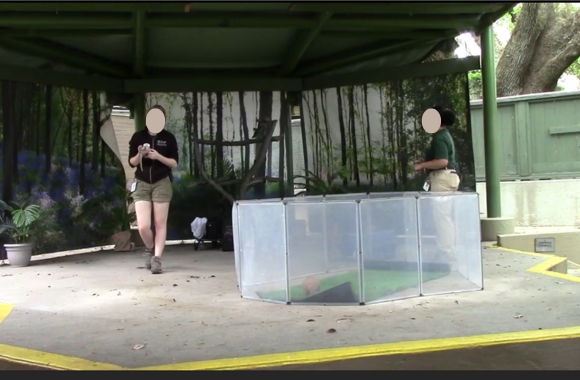
We confirmed these ambassador animal shortcomings at a zoo we recently visited in the U.S. as part of a series of undercover investigations. The zoo was included in a list of the “top ten” AZA-accredited zoos in the country. Our ambassador animal experience involved three ambassador animals: an opossum, bull-nosed snake, and armadillo. First, the keeper set up a two-year-old three-banded armadillo named Julio on the stage in a small three-foot-tall temporary enclosure with clear plastic siding, a small square of turf, and a small rubber ball to play with during the presentation.
In the wild, armadillos typically move at an unhurried pace of no more than one-third mile per hour. For almost the entire presentation (about ten minutes), however, Julio ran in fast, tight, and repetitive circles around the temporary enclosure. When I asked the keeper about this behavior, she stated that it was a “normal” behavior for armadillos, and that they often perform this behavior when foraging for food in the wild. According to armadillo specialists, however, three-banded armadillos typically only run in circles when they feel threatened by a predator and are trying to escape. Therefore, it seems that Julio engaged in that behavior because he felt scared while on display.
Unlike Julio, whose natural habitat lies outside of the U.S., we next observed a demonstration with Teller, a western hog-nosed snake native to southern parts of the U.S. The keeper held Teller in her hands throughout the presentation and indicated that while hog-nosed snakes are venomous, they are not dangerous to most people, as their bite would likely cause the same amount of damage as a bee sting. The keeper failed to mention anything about the negative impacts associated with the reptile pet trade or the dangers of physically interacting with reptiles in captivity or in the wild. Julio remained on-stage and continued running in circles throughout Teller’s demonstration.
Lastly, the keepers placed a three-year-old Virginia opossum named Hazel on a table with her carrier, a strip of turf, and a branch with a small bowl of food positioned at the top. Throughout the presentation, it seemed that Hazel kept trying to go back inside the carrier, but the keeper dissuaded her from doing so each time by holding a treat in front of her face and guiding her away from the carrier door. The keeper told us that the average life expectancy for opossums in captivity is up to four years of age, and in the wild, opossums usually live for just one or two years. The keeper said that she did not know why the life expectancy for opossums is so short, nor did she expand on the main threats that opossums face in the wild that may end their lives after just a couple of years.
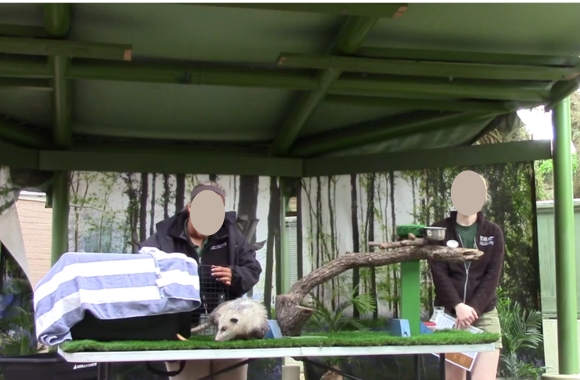
This demonstration occurred in the late morning, when opossums would normally be asleep in the wild; as nocturnal animals, they are most active at night and spend most of their days resting. Thus, using Hazel as an ambassador animal directly conflicts with her normal activity schedule and prevents her from engaging in natural behaviors. None of the demonstrations mentioned the animals’ conservation statuses, the biggest threats to their populations in the wild, or what zoo visitors can do to help these animals in the wild.
Ambassador Animal Programs Send the Wrong Message
It is impossible to justify the use of wild animals for purposes that actively exploit them, negatively impact their mental and physical wellbeing, and clearly do not achieve the educational goals intended by the zoo industry. It is impossible to teach people about wild animals, their behaviors, or their habitats when viewed in unnatural and forced environments like zoos and aquariums. If you agree with us, please share this blog with anyone you know that continues to support the lies the zoo industry perpetuates; all at the expense of the animals they claim to protect.
Keep Wildlife in the Wild,
Devan
Dear Reader,
We are a nonprofit committed to wildlife conservation, welfare, and rescue. Making resources free and widely distributed, like our news items, is an important part of our mission. If you found this article helpful, enjoyable, or enlightening, please donate to help keep these resources available, and Keep Wildlife In The Wild.
Thank You,
The Born Free USA Team


 Dear Reader,