It is with a heavy heart that I write today. We lost our friend, Khy, last week after a short illness. Khy was a Japanese macaque who spent the first two years of his life as a pet. His former owner naively purchased Khy at a wild animal auction as a baby, but she soon began to realize that life as a pet is no life at all for a monkey. While she loved Khy dearly, after 24 months, he was becoming increasingly aggressive towards her and spent more and more time in his cage as his naturally unpredictable behavior became dangerous. His owner began to search for a forever home for him at a reputable sanctuary, and that’s how she found us.
A New Life, and New Friends, at the Primate Sanctuary
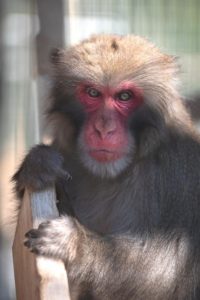
All of the monkeys under our care are special, but Khy held a particular place in the heart of our team. When he arrived 13 years ago, he was little more than a baby and we watched him grow into a beautiful, feisty, comical, and complex adult. Perhaps due to being kept as a pet during his first two years, he retained interest in interactions with his caregivers and had strong friendships with some of them. He might ask to be groomed by putting his shoulder against the enclosure fencing, “lip smack” a happy greeting when a particular favorite friend came to see him, or allow us to sit outside his enclosure in quiet companionship as he foraged, explored, and ate.
He also had certain stereotypies (abnormal behaviors), including self-biting, that he carried with him as he dealt with his past. We had initially hoped that he might be able to live as part of one of our large free-roaming troops in a multi-acre enclosure, but he never truly developed the skills to socialize properly with those of his own kind. As such, he usually lived with just one other monkey at a time. Living in a pair was easier for him and meant that he wasn’t too overwhelmed. This, in turn, meant that his stereotypies – which were triggered by stress – reduced (but never completely subsided) over the years.
Care to the Very End
In the last month, during Khy’s biannual health check-up, it was found that he had cancer. It appeared to be particularly fast spreading and was affecting his lungs, liver, and kidneys. While there was no cure, our expert vet team devised a regimen of treatments for him to keep him comfortable, and to give him as much time as possible. Around two weeks later, he deteriorated swiftly and appeared to be in distress for the first time. The very difficult decision was made to euthanize our friend to ensure that he did not suffer. We said goodbye to Khy on the morning of March 28, 2022.
In those three weeks of end-of-life care, Khy was given every special treat imaginable, and his caregiver friends put time aside each day to spend extra time with him. He quickly caught on and would come running over when someone approached his enclosure, confident that they would have a special treat for him, which he happily devoured, while chattering away and grunting contentedly.
All of the monkeys under our care are special, but Khy held a particular place in the heart of our team.
Khy’s Legacy
Khy’s legacy is not only the many years of memories with the monkeys and staff at the sanctuary, but his story is an integral part of our campaign to ban the keeping of primates as pets in the United States. This is thanks, in no small part, to the willingness of his former owner to speak out about her experience of caring for him and to encourage others to think twice before making the mistake of purchasing a wild animal as a pet. Her testimony has been featured in our recent report on the primate pet trade and featured in our upcoming short documentary to encourage lawmakers to introduce the Captive Primate Safety Act to ban private ownership of monkeys like Khy across the nation. We are grateful for her openness and willingness to come forward to speak out.
While we wish Khy had lived free with his own kind, we will be forever grateful to have had the privilege of caring for Khy over the almost 13 years that he has been with us and hope that his story will inspire the changes needed to protect new generations of monkeys just like him.
We will miss him.
Keep Wildlife in the Wild,
Liz


 Dear Reader,