Born Free USA's Primate Sanctuary
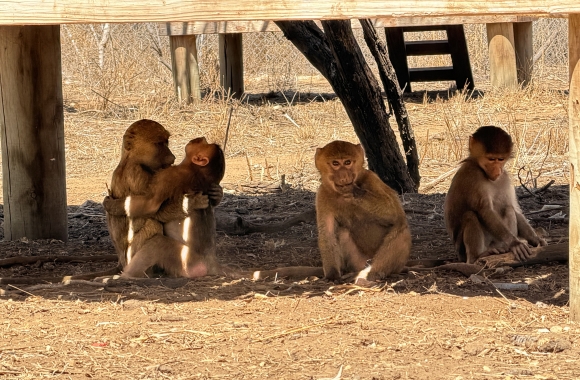
At our primate sanctuary – one of the largest in the United States – our mission is to provide monkeys as high a quality of life as we can. The 175-acre sanctuary, located in south Texas, provides a safe, permanent home to monkeys, many rescued from abuse in roadside zoos or as pets in private homes or retired from animal experimentation.
MEET THE MONKEYSOur History
The original inhabitants of the primate sanctuary were a troop of snow monkeys who arrived in Encinal, Texas from Japan in 1972. They were part of a troop that resided in the Arashiyama forest and was observed by behaviorists since 1954. Due to the primatologists’ providing extra food (provisioning) to the monkeys in order to more easily study them, the original troop grew very large and, around 1970, fractured into two distinct troops.

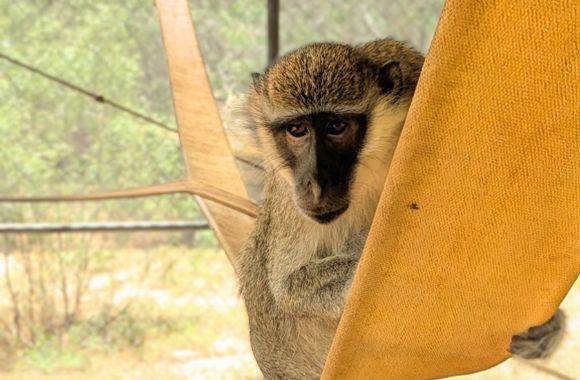
Members of troop “A” soon moved into the Kyoto suburbs in search of food. Because some residents viewed these animals as “pests,” the decision was made to relocate them. A concerned American citizen agreed to pay to transport the group to Encinal, Texas, where a sanctuary was then started. In December 1999, the Animal Protection Institute – which later merged with Born Free USA – took over the management of the Texas Snow Monkey Sanctuary. Since that time, the primate sanctuary has expanded to become a haven for not only descendants of the original trans-located troop, but also monkeys rescued from the pet trade and retired from experimentation or display. Today, the primate sanctuary provides refuge for many species of macaques, vervets, and baboons who were rescued from roadside zoos and private possession or retired from animal experimentation.
The primate sanctuary is also home to a feral cat colony, which lives on a quarter-acre of land. Sanctuary staff provides fresh food, water, and enrichment; and monitors the cats’ health and well-being.
Our Philosophy
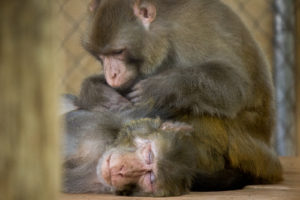
The focus of animal care at the primate sanctuary is to provide conditions in which the captive populations of macaques, baboons, and vervet species are allowed to live out the remainder of their lives with extensive freedom of movement, choice of food, and choice of companions in accordance with their social nature. We aim to provide a lifelong, high standard of care without being needlessly intrusive. Our facility is unique among U.S. sanctuaries in that it is one of the very few to provide large free-ranging environments that allow the majority of the monkeys to live as natural a life as possible with a minimal amount of human interference.
In order to allow the monkeys privacy in their sanctuary home, and to avoid causing stress and anxiety to some of our previously traumatized monkeys, the primate sanctuary is not open to the public.
You Can Help
No matter how a monkey lived before – as a “pet,” in a roadside zoo, or in animal experimentation – at our primate sanctuary, that animal will be able to live out the rest of his or her life in spacious, natural enclosures with ample opportunities for enrichment and socialization. You can support the monkeys in a number of important ways…
Give the wonderful monkeys at the primate sanctuary a brighter future through our adoption program!
Your donation will go directly to the care of the hundreds of monkeys who call the sanctuary home!
Join Our Email List
Sanctuary Stories
October 05, 2026
Donate to the Primate Sanctuary
Your gift allows us to give the monkey residents – many of whom were rescued from abusive situations in roadside zoos, private possession, and in animal experimentation – a second chance for a more natural life.
DONATE NOWThe Numbers That Matter
8
Monkeys rehomed to Born Free USA's primate sanctuary in 2020 - 2021.
175
Size of Born Free USA's Primate Sanctuary in south Texas, in acres.
11
Species of monkey at the Primate Sanctuary: bonnet macaque, long-tailed macaque, pig-tailed macaque, rhesus macaque, stump-tailed macaque, Japanese macaque, olive baboon, hamadryas baboon, Guinea baboon, African vervet, and tantalus monkey.
12
Primate Sanctuary monkeys who can be symbolically adopted.